
What is duty cycling? Duty cycling refers to the practice of operating the Ultrasonic Personal Air...
"How do people wear the UPAS?"
Below, we discuss factors you should consider when figuring out the best way for people to wear the UPAS in your measurement campaign. We then present some examples showing how the UPAS has been worn in prior studies.
Person-focused considerations
When measuring a person's exposure to particulate matter (PM), you would like that person to wear the UPAS as close to the nose and mouth as possible. This desire must be balanced with the requirement that you can only ask a person to wear the UPAS in a way that is comfortable, safe, and interferes minimally with normal activities. As a result, the UPAS is typically worn close to a person's shoulder or against a person's chest.
When sampling in an occupational environment, your primary consideration should be making sure the UPAS is worn in a way that is comfortable, safe, and does not limit a person's normal range of motion. It will be important to make sure the UPAS remains fastened securely against the body so that it does not move around and interfere with other equipment. In an occupational exposure assessment context, the way in which wearing the UPAS affects a person's appearance might be a lesser concern.
In an epidemiological study, people will still need to wear the UPAS in a way that is comfortable, safe, and does not interfere with their normal daily activities; however, the way in which wearing the UPAS affects a person's appearance will likely be of greater concern. In other words, people might not want to wear the UPAS in a harness or vest that draws excessive attention to the fact that they are wearing an air sampler. You might need to consider how the UPAS can be worn on an armband, sash, cross-body bag, vest, or apron that has a socially-acceptable appearance among the population that will be wearing the UPAS.
UPAS-focused considerations
The UPAS must be worn such that the air inlets and outlets indicated in Figure 1 are not obstructed. Depending on the UPAS model, there are one or two key paths through which air flows in and out of the UPAS:
-
The air flow path for the filter sample is present on all UPAS models. Air enters the UPAS through the holes in the size-selective inlet cap ("sample inlet" in Figure 1). After passing through the size-selective inlet, this air passes through the sample filter, where PM is removed from the air and collected. Finally, this air exits the UPAS through the holes on opposite end of the device, where the microUSB port and microSD card are located ("sample outlet" in Figure 1). It's important to remember that the air flowing out of the sample outlet has been filtered and no longer contains PM.
- The air flow path for the optical PM sensor is present on the UPAS v2.1 PLUS only. Air that will pass through the optical PM sensor enters the UPAS through the three slots labeled "sensor inlet" in Figure 1. After passing through the sensor, this air exits the UPAS through the three slots labeled "sensor outlet" in Figure 1.
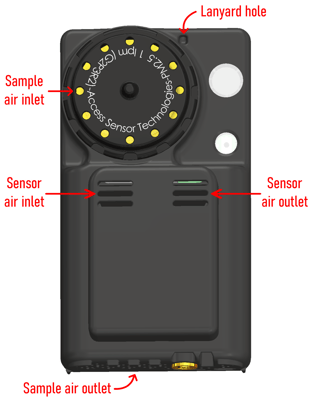
Figure 1. A diagram of a UPAS v2.1 PLUS with air inlets and outlets, as well as the lanyard hole, labeled. The UPAS v2.0 and v2.1 include the same features with the exception of the sensor inlet and outlet slots.
You will need to make sure that, when a person is wearing the UPAS:
- The sample air inlet remains unobstructed.
- The sensor air inlet and outlet remain unobstructed (if you are using a UPAS v2.1 PLUS).
- Air can flow freely out of the sample outlet.
- The filtered air flowing out of the sample outlet is not directed back towards the air inlet(s).
Additionally, consider taking advantage of the lanyard hole to attach the UPAS to a person.
Example approaches
On an armband or cross-body harness
The UPAS can be worn in an armband that is designed to hold a smartphone while running. If you go this route, make sure to select an armband that is designed to hold a phone using rubber straps that will not obstruct the UPAS air inlets or outlets (as opposed to an armband that is designed to encase a phone in a fabric sleeve). Such armbands are typically available from big-box retailers. Some examples are linked below. Note that these links are not meant to indicate that Access Sensor Technologies has tested or endorsed these specific products; they are simply provided as examples to illustrate this approach.
A rubber smartphone holder similar to those linked above can also be used to attach the UPAS to a cross-body sash or harness. Examples are shown in Figure 2.
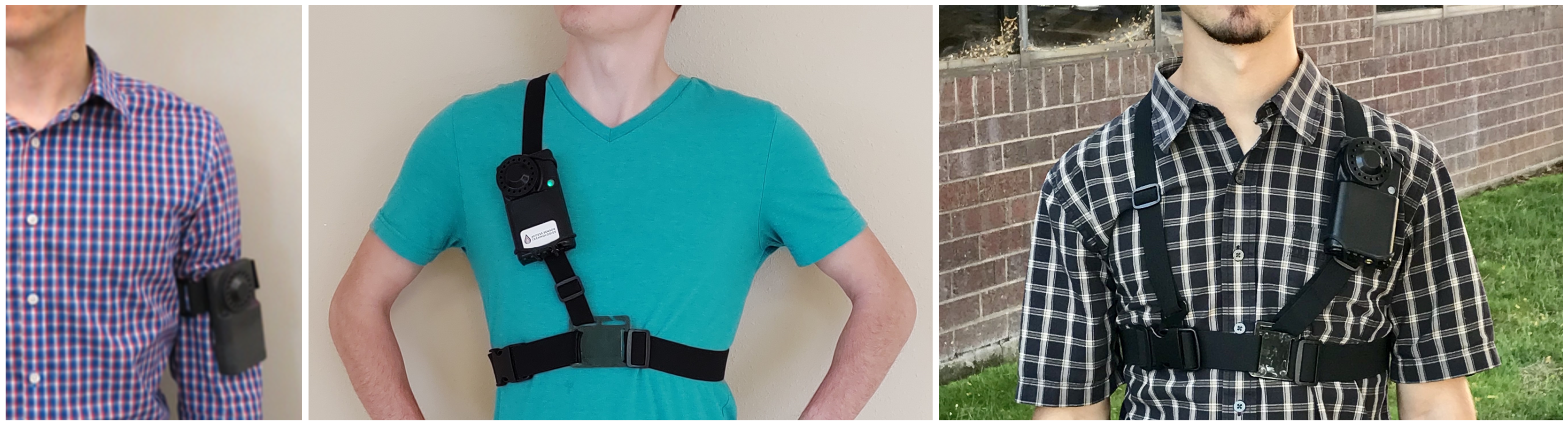
Figure 2. Photographs of a UPAS v2.0 being won on an armband (left) or in a rubber smartphone holder attached to a cross-body harness (center and right).
Attached to the strap of a cross-body bag or backpack
The UPAS can also be worn on the strap of across-body bag or backpack. One example of how this approach can be implemented is shown in Figure 3. The UPAS was worn on the strap of a cross-body bag in studies by Pillarisetti et al. (2019) and Li et al. (2025).
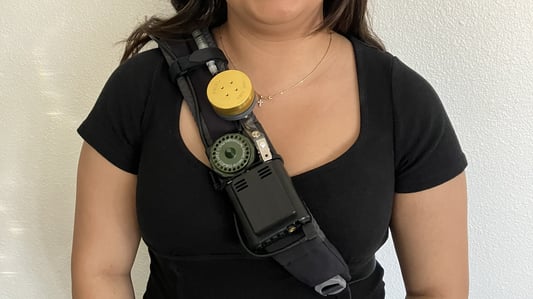
Figure 3. A UPAS v2.1 PLUS attached to the cross-body strap on a sling bag. The UPAS is secured to the strap using: (1) an elastic band that wraps around the UPAS just below the sample inlet and (2) a lanyard that prevents the UPAS from sliding downward.
In a mesh pocket
The UPAS can be worn in a mesh pocket on a backpack, cross-body bag, vest, or apron. For example, during the Sustainable Household Energy Adoption in Rwanda (SHEAR) study, the UPAS v2.1 PLUS was worn in a mesh pocket on a cross-body bag as shown in Figure 4. When a person wore the bag shown in Figure 4, the UPAS rested in the center of the person's chest with the air inlets on the UPAS facing away from the front of the person's body (see Figure S2 in Tanner et al., 2025).
When taking this approach, ensure that the pocket does not obstruct the sample air inlet or the sensor air inlet. Placing the UPAS in a mesh pocket (instead of in a pocket made of solid fabric) will ensure that the sample air outlet holes remain unobstructed and that filtered air flowing out of those holes is not directed back towards the inlet(s).
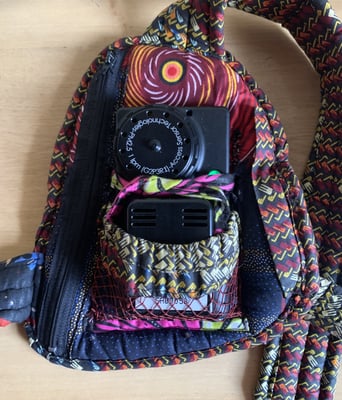
Figure 4. A UPAS v2.1 PLUS in a mesh pocket on a cross-body bag. The sample and sensor air inlets are unobstructed. The mesh pocket allows air to flow freely out of the sample outlet without redirecting that air back towards the inlets.
Prior studies
The publications listed below include images illustrating how study participants wore the UPAS. These approaches conform to the recommendations outlined in the UPAS-focused considerations section above.
- See the UPAS being worn on armbands and cross-body harnesses in Figure 7 in Arku et al. (2018).
- See the UPAS attached to the strap of a small cross-body bag in Figure 1 in Pillarisetti et al. (2019).
- See the UPAS v2.1 PLUS attached to the strap of a small cross-body backpack in Figure S3 in Li et al. (2025). This arrangement is also illustrated in Figure 3 of this post.
- See the UPAS v2.1 PLUS being worn in a small cross-body bag with a mesh pocket in Figure S2 in Tanner et al. (2025). An example of one of these bags is also shown in Figure 4 of this post.